

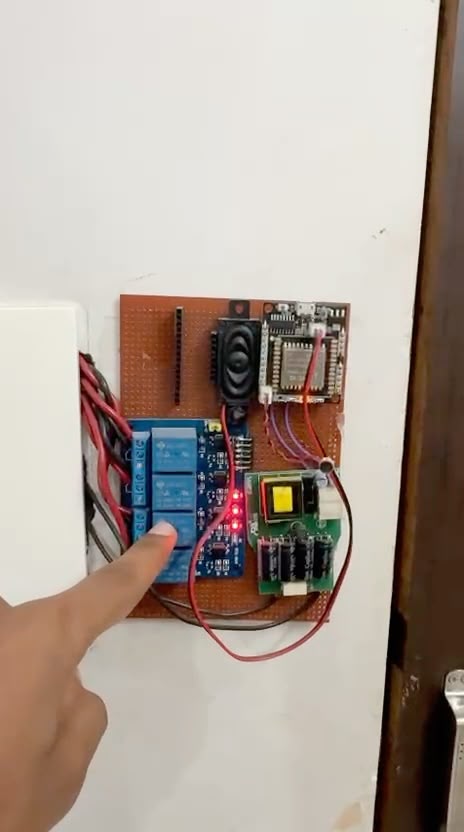
Fifteen-year-old Indian creator Ridit Kumawat has developed a DIY smart-room system inspired by Iron Man’s ‘Jarvis’. The device responds to voice commands to control lights and fans and activate study mode without requiring an internet connection.
The incident took place in Udaipur, in northern India’s Rajasthan, at about 15:27 on November 8.
Visuals show that installed beside his room’s switchboard, the system enables appliance control through voice commands. Users can switch lights on or off and operate fans instantly. It also features preset settings such as ‘Study Mode’ and ‘Goodnight,’ which adjust multiple appliances simultaneously through a single spoken instruction.
15-year-old Indian innovator turns Iron Man’s ‘Jarvis’ fantasy into reality with futuristic voice-controlled smart room
#RiditKumawat #15YearOld #IndianInnovator #JARVISVoiceAssistant #ironman
Full Story👇
https://t.co/O5A4ET2gY1 https://t.co/dYJ9cFKzqi
— Newslions (@newslions_live) November 14, 2026
Speaking to Newslions, Ridit Kumawat, inventor of Jarvis, student of Seedling Modern Public School, Udaipur, Rajasthan, stated that he has turned his fascination with technology and science-fiction inventions into reality by developing an offline voice-controlled smart room assistant inspired by Iron Man’s iconic AI companion, JARVIS. A Class 10 CBSE student at Seedling Modern Public School, Ridit has been exploring electronics and innovative projects since childhood.
His interest in building things began with a simple science experiment in his previous school. He created an electromagnet by wrapping copper wire around an iron nail. What started as a small classroom project gradually developed into a deeper curiosity about electronics and technology. Inspired by Marvel movies, particularly Iron Man, along with smart home assistants such as Google Home and Amazon Alexa, Ridit eventually decided to build his own voice-controlled assistant. He developed an offline voice assistant using the VC02 module and named his creation JARVIS.
Ridit’s JARVIS Offline Voice Assistant is designed to automate household appliances through spoken commands. The system can operate lights, fans, and other electrical appliances while supporting control of up to 16 devices.
One of its key features is its ability to function without an internet connection. Unlike conventional voice assistants that depend on cloud-based services, the VC02-based system processes voice commands locally. This reduces reliance on online connectivity and offers greater privacy.
The young innovator developed the device for less than Rs 3,000. This makes his invention a relatively affordable option for household automation.
Integrating the system with household switchboards and connecting relays to a 220V AC power supply proved to be among the most challenging aspects of development. Ridit independently handled the wiring, programming, and assembly. He referred to the VC02 module’s official datasheet to understand its circuit design and functionality.
The experience helped him develop practical skills in electronics, programming, and automation while gaining valuable exposure to real-world engineering challenges.
Ridit also runs an Instagram page, @the_coder_16, where he documents his experiments and creations. Initially launched as a personal archive of his work, the account has grown into a digital portfolio featuring approximately 33 videos showcasing nearly 30 projects.
Ridit hopes to pursue engineering and secure admission to IIT before eventually establishing his startup. He wants to develop technologies that address practical challenges and improve everyday life.
His JARVIS assistant also has a potential social application. It could help people with limited mobility and bedridden individuals operate household appliances without physically reaching electrical switches. Through simple voice commands, users can control connected lights and fans, potentially improving their comfort and independence.
Ridit’s message to aspiring young innovators is that age should never restrict creativity. He believes every experiment and failure contributes to learning. Rather than waiting for the perfect opportunity or becoming an expert first, young people should remain curious and start turning their ideas into reality.
